
 By mudir
Comboni and Dilexi te
Fr David Glenday, mccj
Missionary Fr David Glenday offers his take on the fifth and last chapter (“A constant challenge”) of Pope Leo’s Dilexi Te on love for the poor, and is encouraged and touched by how several of the Pope’s insights and proposals recall the life and thinking of St Daniel Comboni, first bishop of Central Africa canonized in 1996, and founder of the missionary congregation that bears his name.
Needless to say, the whole Comboni family was delighted to discover their Founder mentioned twice, even if somewhat indirectly, in Pope Francis’ letter Dilexit Nos: yes, the divine and human love of Jesus for all humankind and for every single human being was indeed the centre and source of Daniel Comboni’s remarkable and heroic missionary life.
But what of Pope Leo’s Dilexi Te on love for the poor? Do we find something significant of our founder there? It seems to me that the answer is a resounding and challenging yes – both throughout the Pope’s reflection, and perhaps especially in the powerful final chapter, anyone with ears to hear can pick up the echo of not a few of Comboni’s key insights, placing him within what the Pope calls “the Church’s great Tradition” (103) on care for the poor.
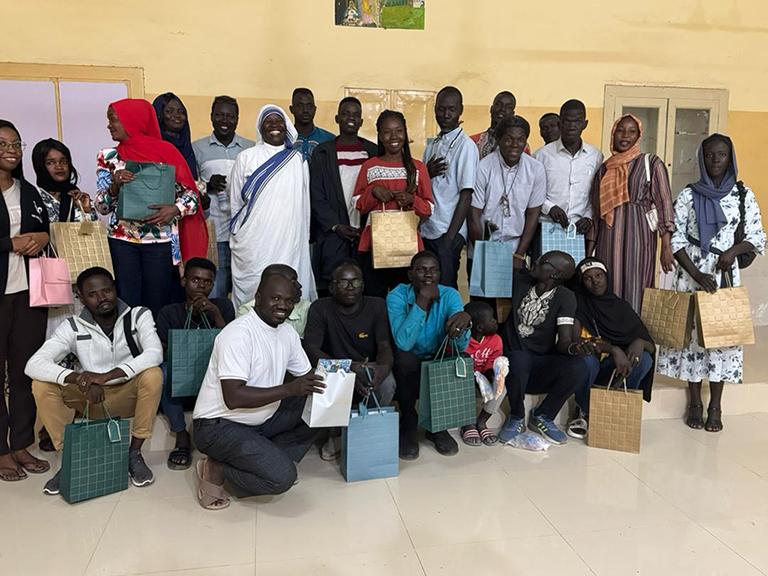
Seeing the poor
Again and again in his letter Pope Leo denounces how easy it can be, even for followers of Jesus, simply not to see the poor, not to notice their existence. In his last chapter he once again draws attention to “a serious flaw present in the life of our societies, but also in our Christian communities. The many forms of indifference we see all around us…” (107).
Comboni, too, would speak of his vocation as a special gift of being able to see the real world and the world’s poor, and to see them in a new way. This, for example, is how he speaks of his prayer at St Peter’s tomb after returning from his first journey to Central Africa: The Catholic, who is used to judging things in a supernatural light, looked upon Africa not through the pitiable lens of human interest, but in the pure light of faith; there he saw an infinite multitude of brothers who belonged to the same family as himself with one common Father in heaven (Writings 2742).
It is striking to note how St Daniel speaks of the poor, in a way very similar to that proposed by Pope Leo: No Christian can regard the poor simply as a societal problem; they are part of our “family”. They are “one of us” (104).
But the matter goes further.
The deep roots of love
Once again using the language of sight and seeing, and quoting Pope Francis, Pope Leo calls on all to respond to the poor person “with faith and charity”, seeing “in this person a human being with a dignity identical to my own, a creature infinitely loved by the Father, an image of God, a brother or sister redeemed by Jesus Christ” (106).
Daniel Comboni spoke of this same faith and charity in deep, experiential terms, telling how in his prayer at St Peter’s “he was carried away under the impetus of that love set alight by the divine flame on Calvary hill, when it came forth from the side of the Crucified One to embrace the whole human family; he felt his heart beat faster, and a divine power seemed to drive him towards those unknown lands. There he would enclose in his arms in an embrace of peace and of love those unfortunate brothers and sisters of his”.
The dynamic of transformation that pulses through these words of Comboni is also very much present in those of Pope Leo when he writes that “the problem of the poor leads to the very heart of our faith” (110), and says that “lives can actually be turned around by the realization that the poor have much to teach us about the Gospel and its demands” (109).
Living love
When Daniel Comboni returned to Khartoum after being ordained a bishop in Rome, he preached a memorable and moving homily to the flock entrusted to his care: “Rest assured that my soul responds to your welcome with unlimited love forever and for each one of you. I have returned among you never again to cease being yours and all consecrated for your greater good in eternity. Come day come night, come sun come rain, I shall always be equally ready to serve your spiritual needs: the rich and the poor, the healthy and the sick, the young and the old, the masters and the servants will always have equal access to my heart. Your good will be mine and your sorrows will also be mine. I make common cause with each one of you, and the happiest day in my life will be the one on which I will be able to give my life for you (Writings 3158-9).
The portrait of mission that Comboni painted in these words turns out to be a celebration of the call Pope Leo makes to the Church today in his Dilexi Te: mission to and for the poor as fundamentally a matter of love, a love that reaches across every divide of time and space, a love that confronts the apparently impossible and expresses itself in concrete action, presence and generosity, and that is as good for the giver as for the receiver. Against this background we can understand that Pope Leo draws his letter to a close with striking lines on the ongoing importance of almsgiving, and thus on a love which is practical, concrete and involves us personally, even if at times in apparently small ways.
As we conclude this journey with Pope Leo’s letter, and with the words and work of St Daniel Comboni vibrating in our hearts and minds, we do well to recall what the Pope says at the beginning of his reflection: “Love for the Lord, then, is one with love for the poor. The same Jesus who tells us, ‘The poor you will always have with you’ (Mt 26:11), also promises the disciples: ‘I am with you always’ (Mt 28:20). We likewise think of his saying: ‘Just as you did it to one of the least of these brothers and sisters of mine, you did it to me’ (Mt 25:40). This is not a matter of mere human kindness but a revelation: contact with those who are lowly and powerless is a fundamental way of encountering the Lord of history. In the poor, he continues to speak to us” (5).